Invest in compassionate clinicians
Your gift to the Department of Physician Assistant Studies supports scholarships, clinical practice experiences, and programs that expand care to underserved communities across Arizona.
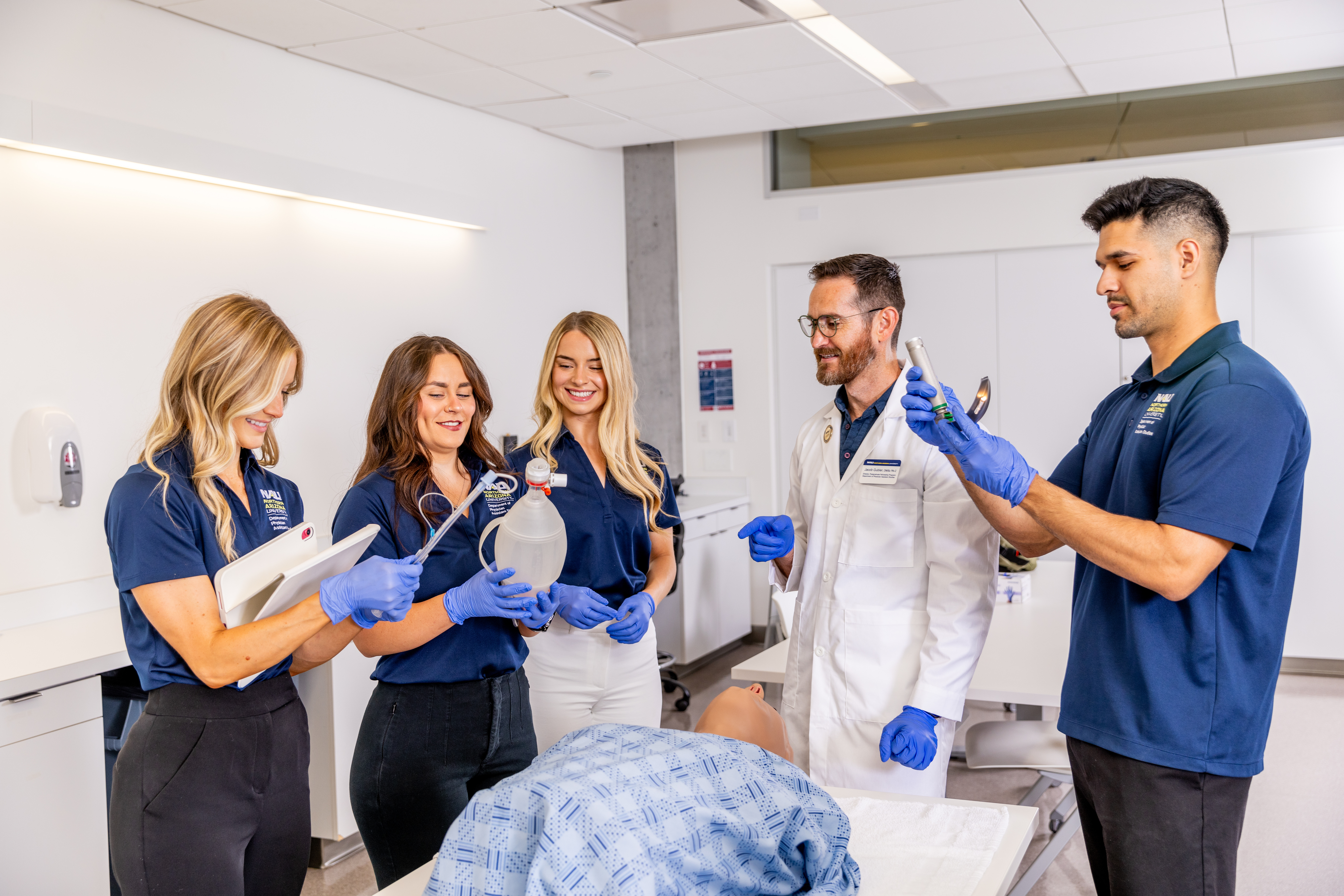
Join a community of compassionate, purposeful clinicians providing care across Arizona. With a graduate degree from NAU, you’ll be leading the state in advancing access to healthcare for communities that need it most.
92% first-time PANCE pass rate
Ranked #1 in Arizona among public university PA programs
Becoming a physician assistant (PA) means more than mastering clinical skills, it’s about improving lives, empowering communities, and shaping the future of healthcare. If you’re drawn to science and helping people, this is a path where your curiosity and empathy will guide your success. PAs work alongside physicians, nurses, and other healthcare professionals to prevent illness, diagnose, and treat conditions, and guide patients safely through recovery.
If you are already a practicing PA, Northern Arizona University offers opportunities to strengthen your expertise and advance your career through specialized certificates, continuing education, fellowships, and the Doctor of Medical Science (DMSc) degree.
NAU’s Department of Physician Assistant Studies will prepare you to lead and practice with expertise and empathy. As a leader in affordable, community-focused PA training, choosing NAU means immersive learning, interdisciplinary collaboration, and a unique focus on vulnerable populations. With programs designed to meet you where you are, whether you’re entering the field or expanding your knowledge, you'll gain the skills and perspective needed to deliver excellence in clinical practice and advance access to quality healthcare.
While pursuing a graduate degree or certificate in Physician Assistant Studies at NAU, you will:
While pursuing a Master of Physician Assistant Studies degree from NAU at the Phoenix Bioscience Core, you’ll learn how to address healthcare disparities and make a real impact in Arizona’s underserved communities. Through programs like Project ECHO and the Community Health Mentor Program, you’ll gain hands-on experience supporting patients in rural, tribal, and low-resource areas. Along the way, you’ll build the skills to provide culturally competent care, navigate complex healthcare systems, and champion health equity in your own community.
Questions? Reach out to PAProg@nau.edu for more information about admission requirements, options for additional science courses, and more.
Participate in a postgraduate fellowship for immersive, interprofessional training in underserved Arizona communities. The Fellowship Program is a 16-month clinical program in rural, primary, and preventative health, providing the knowledge and skills to practice community focused medicine in a rural setting. You’ll gain advanced knowledge in health equity and systems-based care through Project ECHO and real-world clinical practice. By the end of your fellowship, you’ll be equipped to continue your role in addressing some of the state’s most pressing health challenges.
NAU Project ECHO (Extension for Community Health Outcomes) connects multi-disciplinary health professionals in rural communities with specialty teams using zoom technology. These free, bi-weekly virtual sessions bring together healthcare professionals, case managers, social workers, students, and community members to strengthen clinical practice and improve access to care for patients in Arizona’s rural and underserved communities.
Using case-based education, the ECHO model helps participants build the knowledge, confidence, and skills needed to manage complex conditions in their local communities. Continuing education (CE) credits are available at no cost. Get registered and join and our community of learners today!
The university publishes a non-discriminatory policy in compliance with section 504 of the Rehabilitation Act of 1973 and with Title IX of the Educational Amendment of 1972 and consistent with federal and state statutes, rules, and regulations. Additionally, in accordance with the PA program mission, philosophy, and goals, the program will give preference to applicants who indicate a high potential for remaining in the state of Arizona to work following graduation as well as individuals from targeted populations. This includes individuals who are first-generation college students, economically disadvantaged, educationally disadvantaged, underrepresented populations, military veterans, and those from rural backgrounds.
Please send questions regarding the minimum requirements for admission to PAProg@nau.edu. Please note that the options for Additional Science courses have changed: CASPA course subjects that contribute to the Science GPA are accepted as Additional Sciences for this requirement. Science courses intended for science majors and/or upper division level are more competitive for admission purposes.
| PREREQUISITE COURSES | SCH* | COURSE OPTIONS |
| Biological Sciences (REQUIRED) | ||
| General Biology I | 3 | Choose the first part of an introductory level biology course for science majors. Courses for non-science majors are not acceptable. Laboratory component not required. |
| General Biology II | 3 | Choose the second part of an introductory level biology course for science majors. Courses for non-science majors are not acceptable. Laboratory component not required. |
| Microbiology | 3 | Choose an introductory microbiology course. Courses for non-science majors are not acceptable. Laboratory component required. |
| OR Anatomy & Physiology I and Anatomy & Physiology II | 6 | Choose the first and second part of combination A&P. Human focused is preferred. A&P courses for non-science majors are not acceptable. Laboratory component required for both A&P I and A&P II. |
| Anatomy and Physiology | 6 | Anatomy must cover all body systems. Physiology must cover all body systems. Anatomy and Physiology courses for non science majors are not acceptable. Laborary component required for both Anatomy and Physiology. |
| Additional Sciences (REQUIRED) | ||
| Science Courses | 12 | CASPA course subjects that contribute to the CASPA Science GPA are accepted as Additional Sciences for this requirement. Science courses intended for science majors and/or upper division coursework is more competitive for admissions purposes. Laboratory components are not required for these courses. CASPA Course Subjects |
| Chemistry (REQUIRED) | ||
| General Chemistry I | 3 | Choose the first part of an introductory chemistry course for science majors. Courses for non-science majors are not acceptable. Laboratory component required. |
| General Chemistry II | 3 | Choose the second part of an introductory chemistry course for science majors. Courses for non-science majors are not acceptable. Laboratory component required. |
| Organic Chemistry or Biochemistry | 3 | Choose any introductory organic chemistry or biochemistry course. Courses for science and health professions majors preferred. Laboratory component not required. |
| Mathematics (REQUIRED) | ||
| Statistics | 2 | Choose any statistics course in any discipline. |
| Recent Coursework (REQUIRED) | ||
| Required Completion | 9 | A minimum of 9 semester credit hours of science coursework must be completed in the last five years. |
Both the CASPA (Central Application Service for Physician Assistants) and the NAU Office of Graduate and Professional Studies application must be completed by September 1 for consideration.
The application cycle begins in April and closes September 1 each year.
If you have any questions, or you wish to receive e-mail updates, send your request to PAprog@nau.edu. We look forward to hearing from you.
With our Doctor of Medical Science degree and graduate certificates, you’ll build the skills to lead change, navigate complex healthcare systems, and champion health equity in your own community.
The Doctor of Medical Science (DMSc) degree for Physician Assistants (PAs) is an eight-course, 24-credit online post professional doctorate degree program designed to elevate PAs' knowledge and competencies, enabling you to increase their contributions to a patient-centered, safe, and cost-effective health care system.
This flexible, affordable program is offered completely online with no in-person or synchronous attendance requirement. While most students choose to attend part-time, the program can be completed in as little as one year with full-time enrollment.* Take your courses in any sequence or pace that you like. Each of our courses is approved for 15 hours of AAPA Category 1 CME (120 category 1 hours for the full program).
Students may apply to the program at any time.
Each of the courses in the graduate certificate curriculum are approved to offer 15 credit hours of AAPA Cat 1 CME. Apply now.
At NAU, support goes beyond the classroom. Faculty are invested in your growth and provide mentorship and guidance throughout your journey. You’ll also benefit from a collaborative, inclusive environment that emphasizes both personal and professional development. Through clinical placements and licensure exam preparation, you’ll be ready for the impactful work you’ve aspired to.

"The work I do as a physician assistant is rewarding because I have the privilege of offering compassionate care to those who might otherwise go without. By taking the time to understand the broader context of my patients’ lives, I can better address their unique needs and help them navigate the complex healthcare system."


Apply to one of Northern Arizona University’s Department of Physician Assistant Studies programs to gain the advanced training, meaningful experience, and supportive professional community that empower you to enhance healthcare delivery where it’s needed most.

Your gift to the Department of Physician Assistant Studies supports scholarships, clinical practice experiences, and programs that expand care to underserved communities across Arizona.